

Imagine your morning coffee maker talking to your car. Your doctor could check your health from miles away. This isn’t science fiction—it’s what 5G technology is making real.
Every day, cities like New York and Los Angeles are getting faster. Their networks are now 100 times quicker than before. It’s not just about quick downloads. It’s about a future where everything works together perfectly.
Key Takeaways
- 5G advancements are unlocking global connectivity for smart cities and IoT devices.
- Hyper-connected world possibilities include remote healthcare and autonomous vehicles.
- 5G technology reduces delays, making real-time interactions between devices possible.
- Deployments in the U.S. and worldwide highlight both opportunities and challenges.
- Next-gen networks like 6G promise even more transformative changes ahead.
Introduction to the 5G Revolution
5G technology is more than just an upgrade. It’s a game-changer for mobile networks. It offers speeds up to 100 times faster than 4G and has almost instant latency. This means users can enjoy smooth video calls, quick app downloads, and reliable connections, even in crowded places.
Businesses also benefit greatly. They can power smart factories, create autonomous systems, and analyze data in real-time. This technology is a key part of the digital transformation in many industries.
Operators like Verizon and AT&T are working to expand 5G in U.S. cities. South Korea and China have already covered their entire countries. The U.S. aims to reach 90% of urban areas by 2025.
This expansion supports the digital transformation of various sectors. Imagine farms using drones for monitoring or hospitals doing remote surgeries. 5G makes these scenarios possible.
“5G isn’t about speed alone—it’s the backbone of tomorrow’s innovations.” – 2023 GSMA Report
5G’s low latency and massive connectivity open up new possibilities. It supports smart cities, autonomous vehicles, and more. As mobile networks evolve, 5G is the foundation for a connected future.
Understanding Advancements in 5G Technology
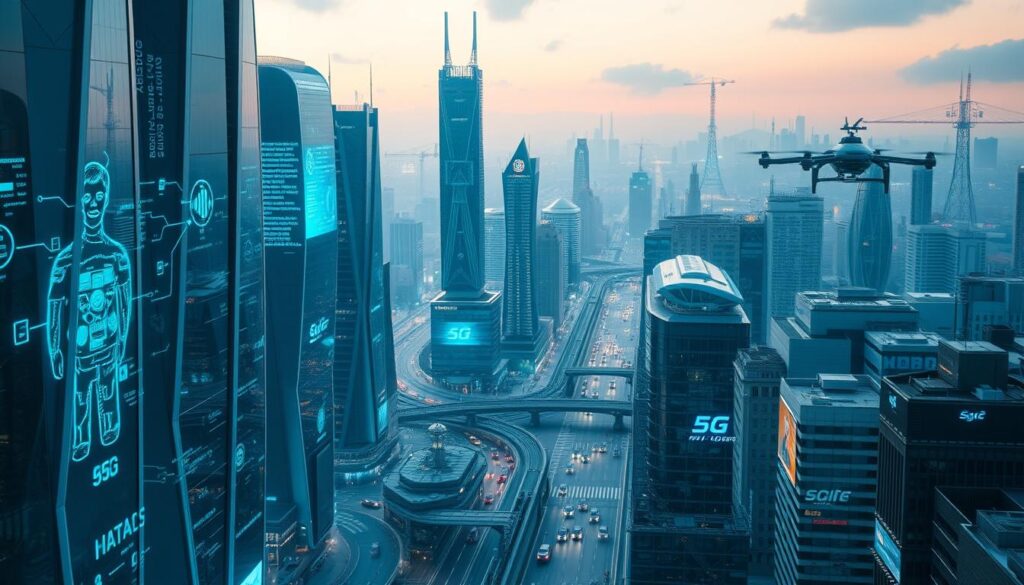
5G technology is a big step up in wireless connectivity. It allows for faster data transfer and lower delays. This makes it the foundation of next-generation wireless tech. Let’s explore how these changes affect how we connect.
The Technical Evolution from 4G to 5G
5G networks are different from 4G. They use smaller cells and edge computing to process data near users. This makes them more reliable and fast.
Key Components of 5G Infrastructure
- Small Cells: Compact antennas placed densely to improve coverage.
- Massive MIMO: Uses multiple antennas to boost signal strength and capacity.
- Beamforming: Directs signals to specific devices, reducing interference.
- Edge Computing: Processes data locally to minimize delays.
Speed and Latency Breakthroughs
| Technology | Speed | Latency | Use Cases |
|---|---|---|---|
| 4G | Up to 100 Mbps | 50 ms | Streaming, basic IoT |
| 5G | 1 Gbps+ speeds | 1 ms or lower | Autonomous vehicles, telemedicine |
Spectrum Allocation and Network Efficiency
5G uses three spectrum bands: low-band (wide coverage), mid-band (good speed and coverage), and high-band (very fast speeds). Network slicing lets operators divide networks for different uses, like smart cities or industrial IoT.
Building the Foundation for a Hyper-Connected World
5G’s global rollout is more than just faster speeds. It’s the backbone of a smarter, interconnected future. This section explores how key advancements are shaping everyday life through technology that’s both accessible and transformative. and key advancements in india are Starlink India Launch
The Backbone of Internet of Things (IoT) Ecosystems
IoT devices rely on 5G to function seamlessly. From smart home systems to industrial sensors, 5G’s low latency ensures real-time data sharing. AT&T and Ericsson are already deploying IoT networks in agriculture, optimizing crop yields through soil sensors and climate monitoring.

Smart Cities and Infrastructure Development
“5G turns cities into living networks.” — Barcelona City Council, 2023
Barcelona’s 5G-powered traffic systems reduce congestion by 25%. This is thanks to IoT-enabled streetlights and parking sensors. Energy grids in Tokyo now predict demand spikes, cutting waste through 5G-enabled smart meters.
Connectivity Solutions for Rural and Underserved Areas
- Verizon’s 5G Fixed Wireless delivers broadband to rural U.S. households without fiber-optic lines.
- AT&T’s 5G Extended Range expands coverage to remote regions.
The Promise of Free Internet Initiatives
Projects like Google’s Project Loon and Starlink aim to provide free or subsidized internet. These programs target schools and healthcare facilities in underserved regions, ensuring equitable access.
From IoT devices to free internet programs, 5G is the framework enabling a world where connectivity isn’t a luxury but a universal standard.
5G Applications Transforming Industries
5G technology is changing the game in many industries. It’s making things that were once dreams a reality. From hospitals to factories, it’s making connections better and faster. Let’s see how it’s making a big impact.
| Industry | Application | U.S. Example |
|---|---|---|
| Healthcare | Remote surgery and real-time patient monitoring | Mayo Clinic’s 5G-enabled telemedicine trials |
| Manufacturing | Predictive maintenance and autonomous robotics | Caterpillar’s IoT sensors in smart factories |
| Transportation | Vehicle-to infrastructure communication | Detroit’s 5G-powered traffic management systems |
| Entertainment | 4K live streaming and AR/VR experiences | Verizon’s 5G-driven live sports broadcasts |
“5G isn’t just faster speeds—it’s the catalyst for industry-wide reinvention,” states Verizon’s 2023 connectivity report.
In healthcare, surgeons in New York have done cross-country consultations with 5G. This has cut down on delays. Factories are using 5G sensors to predict when equipment might fail, saving time.
5G also helps cars talk to traffic lights, making roads safer.
Cities like Chicago and Las Vegas are using 5G for traffic control. The entertainment world is streaming concerts in 8K quality, reaching fans worldwide. As 5G grows, more industries are finding new ways to use it, boosting the economy.
Challenges and Opportunities in 5G Implementation
As 5g technology changes industries, its use faces big hurdles. These need global teamwork. From keeping data safe to making policies, each step is a balance of new ideas and careful planning.
Security Considerations in Next-Generation Wireless Technology
Keeping networks safe is key as 5G grows. Next-generation wireless technology uses strong encryption and partnerships. For example, Cisco works with governments to protect networks. But, there are risks in the supply chain, like the U.S. banning Huawei to protect its networks.
Regulatory Frameworks and Global Standardization
Groups like the FCC and global bodies set rules for using spectrum and standards. They make sure devices can talk to each other without problems. This helps with digital transformation across the world.
Economic Implications and Investment Landscapes
5G needs a lot of money: GSMA says over $1.9 trillion by 2026. Companies like Verizon and AT&T are leading the way. While it costs a lot, it also creates jobs in tech and smart manufacturing.
Addressing Health and Environmental Concerns
There are debates about 5G’s health effects, but the WHO says there’s no proof of harm. Companies like Ericsson and Samsung are making base stations that use less energy. This helps the environment while we move forward.
By tackling these challenges, we can unlock 5G’s power to change the world. Working together will show its true value.
Beyond 5G: The Road to 6G and Future Connectivity
As 5G changes industries now, engineers are planning for 6G. This new tech will offer speeds over 1 terabit per second and almost instant data transfer. It will make a hyper-connected world where data moves smoothly everywhere.
Research teams at Ericsson and Huawei are looking into big upgrades. They’re exploring terahertz frequencies for super-fast data, quantum encryption for top security, and satellite networks to connect the globe. These advancements could lead to holographic calls, smart cities run by AI, and health monitoring devices.
“6G won’t just be faster—it’ll integrate intelligence into every connection.”
- Timeline: Trials expected by 2028, commercial rollouts by 2030
- Goals: 1,000x bandwidth, 100x connection density, AI-native networks
These new features will change many areas, like remote surgery and self-driving cars. Imagine classrooms with 3D models from around the world or doctors using robots for surgery. 6G aims to remove physical barriers.
Today’s 5G is just the start. Places like MIT and Ericsson’s research centers are working on the basics. The future isn’t just about speed. It’s about changing how we live in a world where connection is everywhere.
Conclusion
5G is changing how we connect, moving us toward a world where tech is part of our daily lives. It’s making cities smarter and cars drive themselves. This tech is also helping in healthcare, making things faster and better.
Now, we can send data in real-time, which is opening up new possibilities. For example, doctors can do surgeries from far away. This is not just a small step forward; it’s a big change that will help us even more in the future.
But, there are challenges like keeping data safe and figuring out rules. Yet, we’re making progress. Companies like Verizon and AT&T are working hard to cover more areas. They’re making sure everyone can connect.
There’s also a push to make sure 5G works the same everywhere. This means more money going into making 5G a reality. Even as we start talking about 6G, the work on 5G is key to solving today’s problems and preparing for tomorrow.
In the U.S., 5G is more than just fast internet. It’s about making new things possible. It’s helping in emergencies and making work from home better. As we build more, American businesses can lead in the tech world.
The path to a fully connected world is long, but 5G is a key part of it. It’s not just about being connected; it’s about building a future where anything is possible.